The brightest pixel strip on the market.
PXP170
5,000 lm burst · 2,600 lm/m sustained · CRI 90 · RGBW
Uncompromising light quality engineered for the most demanding applications. The PXP170 delivers exceptionally bright, high-CRI colors that render perfectly on broadcast and film. Built to perform flawlessly under pressure, it rigs in minutes without tools and features hardware-level fault protection so a single point of failure never stops the show.
Light quality that stands up to the closest lens
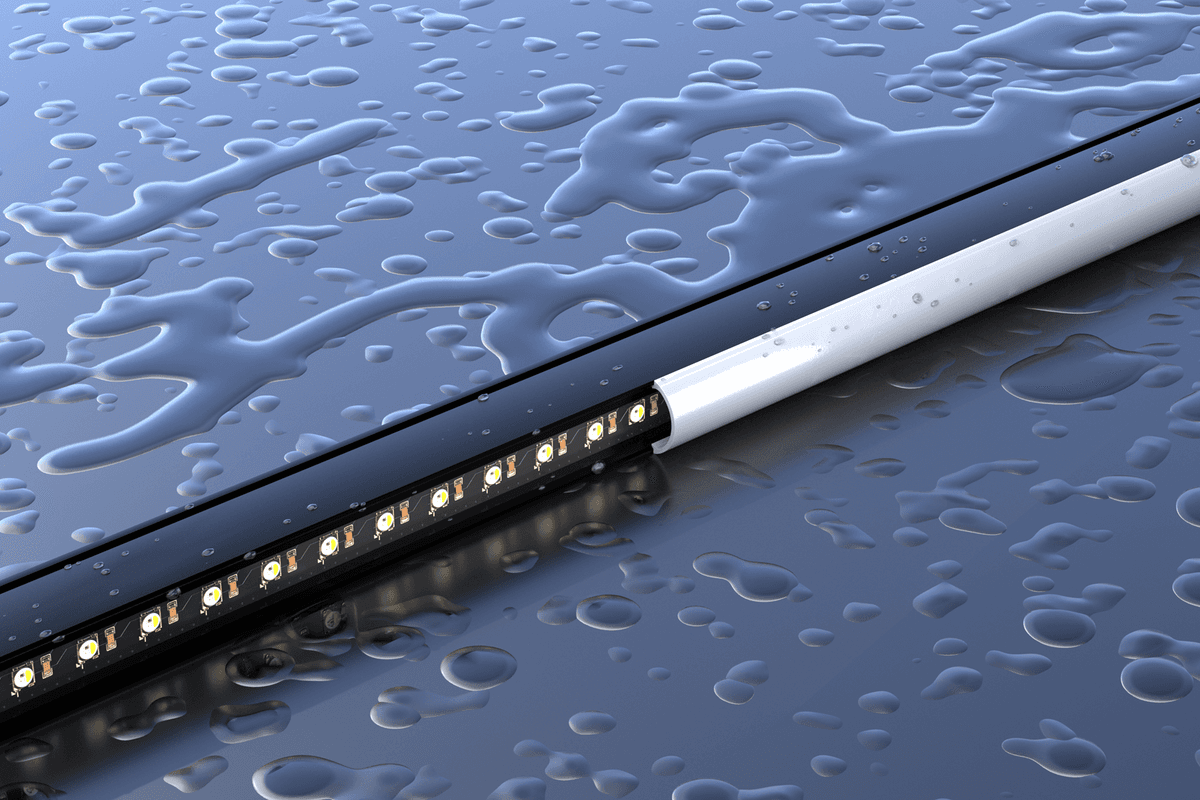
A fixture is only as good as the light it produces. The PXP170 delivers 5,000 lumens of burst output and 2,600 lm/m sustained — the brightest pixel strip on the market — at CRI 90. Colors read true on broadcast, film, and live camera work, and the dedicated white channel gives clean whites and pastels with no green-magenta tint. What you see on the monitor is what you get in post.
5,000 lm Burst · 2,600 lm/m Sustained
Sustained output stays bright all night to fill large surfaces and punch through haze. Burst hits add an extra kick for accents and peak moments — brighter per meter than any competing strip.
CRI 90
A color rendering index of 90 means the PXP170 reproduces colors as they actually appear under natural light. Skin tones, fabric colors, and set pieces look accurate on camera — not shifted or washed out. Critical for broadcast, film, and any application where color truth matters.
Dedicated RGBW
A separate white LED channel delivers high-CRI whites directly instead of mixing them from RGB. The result is cleaner whites, better pastels, and no green-magenta tint at low levels — the artifacts that give away cheap LED fixtures on camera.
32,000 Hz — Zero Flicker
At over 8× the refresh rate of competing fixtures, there is zero visible flicker at any shutter speed. Shoot at 1,000 fps and every frame is clean — no banding, no strobing, no post-production fixes.
16-Bit Color Depth
65,536 brightness levels per channel. Gradients stay smooth at the lowest dim levels where 8-bit systems show visible stepping. Critical for close-up camera work and slow color transitions.
Three Brightness Modes
High-brightness mode pushes the full burst output for peak moments. Balanced mode evens out perceived brightness across all hues for consistent color. Power-save mode cuts draw for long-running installs.
Deploy in minutes, not hours
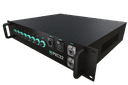
Traditional pixel rigs eat half of get-in day on mounting hardware, threading cables, and assigning addresses. The PXP170 eliminates every one of those steps. Profiles snap onto their rails, lock together with a push, and the controller discovers the chain automatically. You go from flight case to first pixel in minutes.
Snap-On Mounting
Brackets attach directly to the full-length M4 and M10 rails without tools. Reposition profiles in seconds during setup or between shows. No wrenches, no bolts, just hands.
Click-to-Connect Cabling
IP67 push-lock connectors carry power and data in a single cable. No screwing, no crimping. Daisy-chain 10 profiles wearing gloves. Swap a damaged cable without touching the profiles.
Hot-Plug Reconfiguration
Add or remove profiles under full power. The controller detects the new chain topology and reconfigures within a single frame. No restart, no re-patching, no downtime.
Designed so failures don’t become emergencies
A pixel dies mid-show. A profile takes a hit during load-in. A cable gets yanked under power. With conventional LED fixtures, any one of these stops the chain and kills the output. With the PXP170, the audience never knows. We designed six independent layers of protection so that every realistic failure scenario is contained, reported, and recovered from — automatically, at the hardware level, faster than a single frame.
Layer 1 — Pixel-Level Bypass
Each of the 85 pixels has its own dedicated driver. If one LED fails, the data signal routes around it and every downstream pixel keeps working normally. No dead chain segments. No dark patches spreading across the strip.
Layer 2 — Profile-Level Bypass
If a whole profile loses power or its processor locks up, the hardware physically bridges the data line around it. The nine profiles downstream never even see a glitch. Pull a damaged unit off the rig and the chain closes behind it.
Layer 3 — Redundant Return Data Path
A dedicated return line runs from the last profile back to the controller. The controller knows the exact chain topology every frame: how many profiles are present, in what order, and whether any have dropped out. Reconfiguration happens within a single 16.7 ms frame.
Layer 4 — Continuous Health Monitoring
Every profile reports its temperature, supply voltage, current draw, and LED count back to the controller 60 times per second. You see a potential thermal issue or voltage drop building before it causes any visible effect — not after.
Layer 5 — Full Galvanic Isolation
Power and data are fully isolated on every single profile. A short circuit, a voltage spike, or water ingress on one unit cannot propagate to the chain or reach the controller. The fault stays where it started.
Layer 6 — Live Hot-Swap
Connect or disconnect any profile under full power. No inrush transients, no data corruption, no breaker trips. Replace a damaged unit mid-show and it joins the chain automatically.
Specifications
Light Output & Performance
Connectivity & Power
Protection & Monitoring
Physical & Accessories
Ready to light up your next project?
Contact us for personalized pricing and technical details. Fast, expert response guaranteed.